


REDUCE INFECTIONS:
Developed by the NHRI, the IoT-based system aims to boost hygeine compliance among healthcare workers and reduce preventable infections
-
By Lee I-chia /
Staff reporter
A research team at the National Health Research Institutes (NHRI) yesterday said that it has developed a hand hygiene detection system to monitor healthcare workers’ compliance and reduce healthcare-associated infections.
The system, which integrates Internet of Things (IoT) technology, demonstrated 72 percent accuracy during clinical testing in an adult intensive care unit (ICU), the team said.
Healthcare-associated infections are among the most common adverse events in healthcare settings, with risk factors including poor hand hygiene.

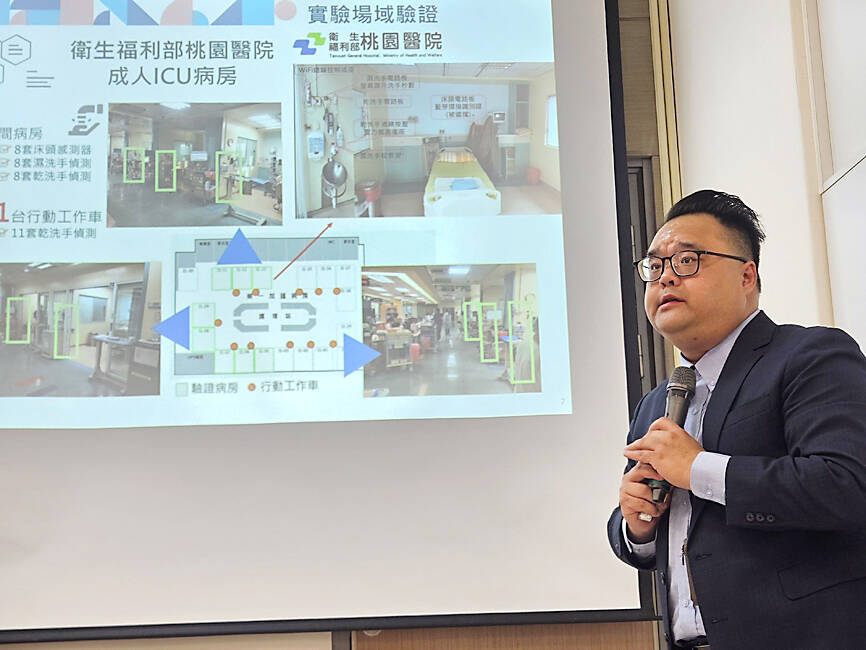
Photo: CNA
Research suggests that 20 to 70 percent of healthcare-associated infections are preventable through improved hygiene, they said.
“Proper hand hygiene is essential to prevent the cross-transmission of healthcare-associated infections and multidrug-resistant organisms,” the team said. “Yet, the global average compliance rate among healthcare workers remains only 40 percent.”
Taoyuan General Hospital deputy superintendent Cheng Shu-hsing (鄭舒倖) said international standards for monitoring hand hygiene include the “appropriate hand hygiene actions” and the “correct timing.”
However, traditional methods, such as direct observation by trained personnel, are limited by labor resources, interruptions and the Hawthorne effect, in which people alter their behavior when they know they are being observed, she said.
As Taiwan’s first hospital-acquired COVID-19 infection was traced to poor hand hygiene by a physician at Taoyuan General Hospital in January 2021, the hospital partnered with the NHRI to develop a more effective, automated handwashing monitoring system.
Liao Lun-de (廖倫德), deputy director of the NHRI’s Institute of Biomedical Engineering and Nanomedicine and a member of the research team, said the team focused on developing a comprehensive hand hygiene monitoring system that integrates IoT technology to track soap-and-water handwashing and the use of alcohol-based hand sanitizers.
The system also includes real-time data visualization through a Web-based interface to monitor healthcare workers’ hand hygiene practices, he said.
The system uses Bluetooth sensors to detect healthcare workers’ locations and identify handwashing with soap and water, ultrasonic sensors to measure handwashing duration and pressure sensors to detect the use of alcohol-based hand sanitizers, he said, adding that healthcare workers only need to wear a radio frequency identification wristband to enable detection.
A cloud server, database and Web site have been established to manage and display the data collected by the IoT devices, allowing for instant calculation of compliance and accuracy rates, Liao said.
The system does not use surveillance cameras or record images, thereby preserving individual privacy, he said, adding that clinical testing in an adult ICU showed the system achieved 72 percent accuracy, Liao said.
“Our purpose is not to catch people for lapses in hygiene,” Liao said. “Rather, we want the system to help identify when healthcare workers enter or exit an ICU and whether they follow proper hand hygiene protocols.”
The team is also considering developing a wristband function that would alert healthcare workers if they fail to wash their hands with soap and water for at least 40 seconds, he added.
The team’s findings were published as the cover article of the multidisciplinary open-access journal Global Challenges in December last year.
link