
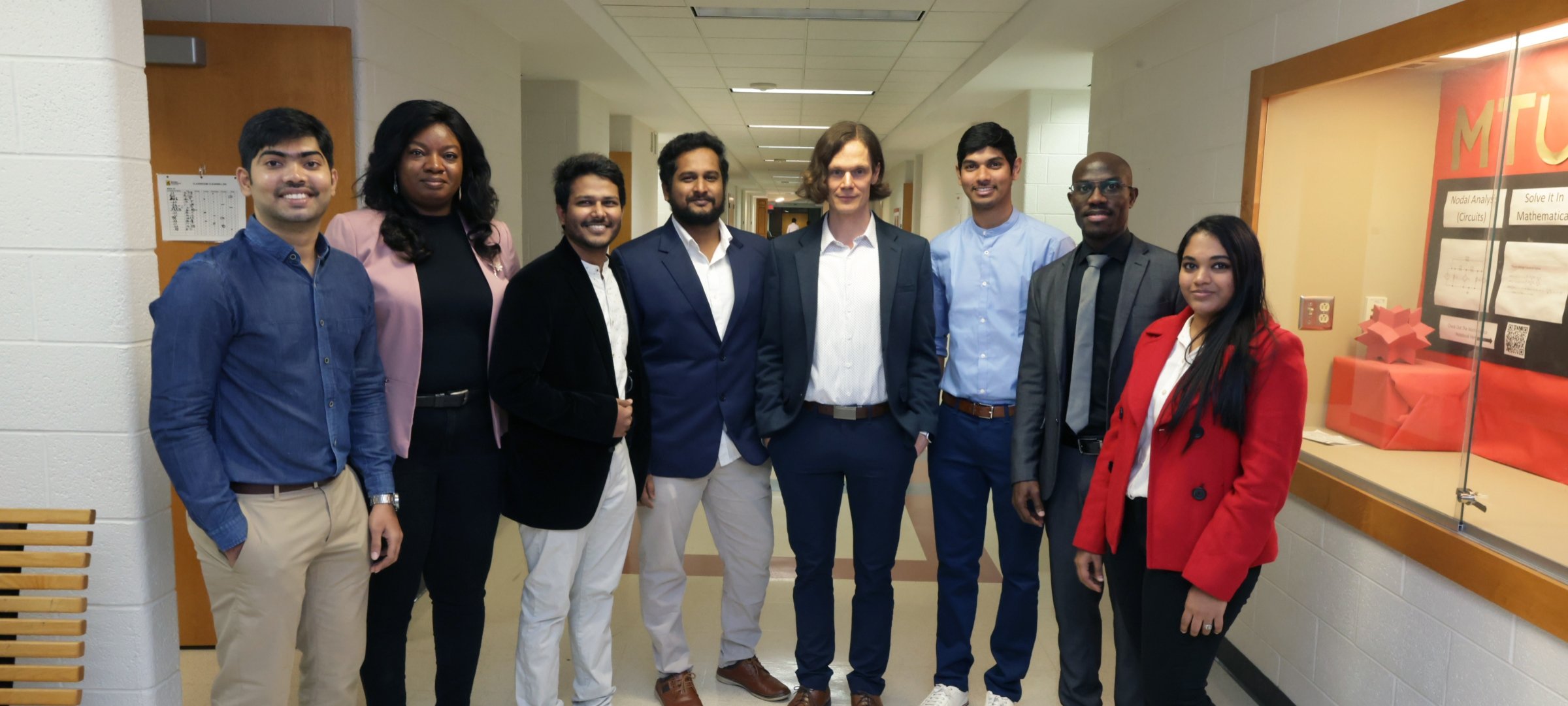
In the world of biomedical data science, Associate Professor Guy Hembroff of the Department
of Applied Computing has emerged as a leader in innovative research projects that
aim to improve mental and physical healthcare.
Hembroff’s work—centered on early detection and preventive and responsive customized solutions
for patients and medical personnel—is enhancing safety and patient health outcomes
through AI-based clinical decision models. Following is a summary of Hembroff’s current
research projects, each contributing to the broader goal of transforming healthcare.

Proactive and Responsive Holistic Wellness Solutions in K-12 Schools
This project focuses on K-12 schools and their responsibility for the well-being of
students. Harnessing the potential of artificial intelligence (AI), the research provides
real-time insights into students’ mental health. Through the analysis of data from
sources including social/emotional check-ins, social determinants of health, and wearable
devices, academic institutions are empowered to better understand students’ well-being.
The goal is to offer timely support and customized resources to ensure that students
receive the best possible care. Hembroff is working on a commercial application initially
funded by the National Science Foundation Innovation Corps (I-Corps™).
Enhancing Emotional Wellbeing through AI-enabled Self-regulation Interventions
Mental health disorders represent a significant global challenge. Hembroff’s research
in this area seeks to leverage AI, specifically natural language processing (NLP)
and deep learning models, to enhance emotional well-being through personalized interventions.
By monitoring emotional states in real time using wellness apps and wearables, this
work aims to recommend safe and effective interventions, ultimately improving patient
outcomes. The Institute of Computing and Cybersystems (ICC) awarded Hembroff Rapid Seed Funding to support the early stages of this work.
Guy Hembroff, Yu Cai to Receive Provost’s Award for Sustained Teaching Excellence
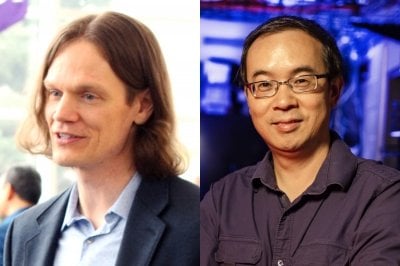
Guy Hembroff, associate professor in the Department of Applied Computing, and Yu Cai, professor and associate chair in the Department of Applied Computing, are recipients
of this year’s Provost’s Award for Sustained Teaching Excellence. The award provides special recognition to instructors who have been nominated as
finalists for the Distinguished Teaching Award four or more times. With this recognition, Hembroff and Cai are also members of Michigan
Tech’s Distinguished Teaching Academy, an elite group of faculty with an established reputation for excellent teaching.
Automated Quality Control of MSK Radiographs using Deep Learning
Quality control is crucial in the field of radiology. Hembroff’s collaborative project
with Henry Ford Health Radiology focuses on automating the quality control process for musculoskeletal radiographs.
A convolutional neural network model is used to detect and classify various aspects
of the radiographs. The research not only improves the efficiency of radiology workflow,
it enhances patient safety by ensuring accurate imaging.
Fracture Risk Predictions through Opportunistic Screenings
Osteoporosis is a significant concern, particularly among the aging population. This
project aims to develop a deep learning model capable of the early detection of low
bone mass using existing knee radiographs. The approach minimizes the need for additional
imaging and reduces healthcare costs. It also enhances patient safety and well-being
by expediting diagnosis and treatment. The project is funded by and conducted in collaboration
with the radiology and imaging department of Henry Ford Hospital in Detroit.
Public Health Disease Surveillance Architecture and Modeling
In collaboration with nonprofit hospital network Upper Peninsula Health Care Solutions (UPHCS), Hembroff’s team is working on a secure web-based patient registry for disease
surveillance. Through data-driven insights, the project enables real-time decision-making
and policy development and contributes to improved public health outcomes and the
safety of communities. The work is funded by the Michigan Health Endowment Fund.
Enhancing Behavioral Health Capacity and Clinical Decision Modeling
This collaborative project focuses on creating a secure patient registry for use in
integrated care settings. The registry records valuable information about patients’
behavioral health, so care management personnel can make informed decisions. By translating
data into critical visualizations and analytics, the project enhances healthcare and
outcomes for patients. The work is conducted in collaboration with UPHCS and funded
by a Michigan Department of Agriculture and Rural Development Rural Readiness Grant.
Graduate Profile: Ifunanya Akpoveta
While working in Nigeria’s health sector, Pharm Ifunanya Emmanuella Akpoveta (née
Ezeumeh) noted a need for professionals with both clinical and technical skills. She
wanted to pursue a graduate degree where she could gain those skills— and she found
that a career in health informatics was the perfect fit.
In December 2023, Akpoveta received her MS in Health Informatics from Michigan Tech, with concentrations in public health informatics and artificial intelligence in healthcare.

“This degree provided me with all the requisite skills to become a health informaticist,” says Akpoveta. “By the end of the program, I had mastered the skills of analyzing
health big data and developing and applying artificial intelligence to improve the
delivery of healthcare services.”
Akpoveta says Guy Hembroff, associate professor of applied computing, was an exceptional
mentor and advisor, challenging her to approach new problems with curiosity and to
think critically and creatively. Additional faculty mentors were Assistant Professors
Weihua Zhou, Department of Applied Computing, and Xiaoyong (Brian) Yuan, who is affiliated with both the applied computing and computer science departments.
“Dr. Hembroff has been incredibly supportive of my academic and professional goals
and has helped me identify and pursue opportunities that align with my interests and
aspirations,” says Akpoveta. “I am grateful for his guidance, support, and motivation.
His commitment to my success has been instrumental in my academic and professional
development.”
Under the guidance of Hembroff and Yuan, Akpoveta worked on several research projects
at Michigan Tech. “In population health informatics research, I used machine learning
algorithms to predict the risk of cardiovascular disease and polycystic ovarian syndrome,”
she says.
In medical imaging informatics research, Akpoveta worked on the classification of
brain tumors in magnetic resonance imaging (MRI) scans using convolutional neural
networks. She says the research aims to auto-classify brain tumors while reducing
the workload of radiologists.
During her time at Tech, Akpoveta was vice president and social chair for the African Students Organization and was active in Graduate Student Government, among many other activities. She says the best part of being at Michigan Tech was
the relationships she built.
From High School Setbacks to Mastering Resilience
Michael Dabish ’20 ’23
Years ago, Guy Hembroff, director of Michigan Tech’s MS in Health Informatics program,
was grabbing something to eat at a local Subway restaurant. Michael Dabish, then a
first-year undergraduate student majoring in computer network and system administration (CNSA), was working there at the time.
“I was impressed with Michael’s career aspirations in our short initial conversation.
Soon after, we hired him to assist in our labs and he never stopped impressing us,”
says Hembroff. “Michael was a terrific student and is an even better person.”
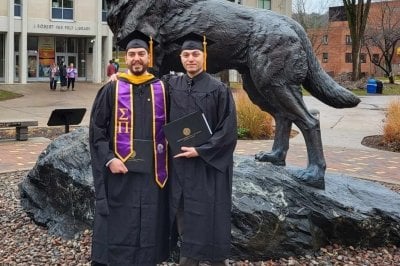
Dabish completed his Bachelor of Science in CNSA in 2020 and his master’s in health
informatics in December 2023. His success may have surprised those who knew him in
high school, where Dabish struggled academically.
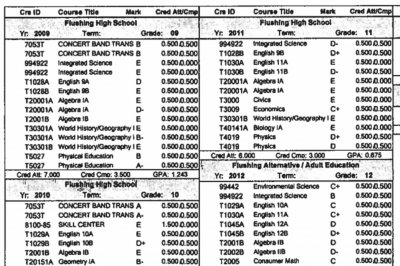
“Looking back on my high school experience 10 years ago, when I graduated with a GPA
below 1.0, I never would have considered this accomplishment a possibility. Typically,
kids with those grades don’t even attempt college,” says Dabish.
But Dabish knew he was made for more. “Overcoming the odds of completing my undergraduate
degree, and going a step further in my educational career is something that I am very
proud of,” he says. “I wish I could go back and tell my high school self that everything
would be okay, to embrace the challenges, and to let those barriers fuel the journey
for growth and knowledge.”
Dabish studied health informatics because he wanted to apply his knowledge of technology
to the healthcare field. MTU professors encouraged him, knowing his expertise would
give him an edge in that industry, which lags behind others in interoperability—the
degree to which software systems, devices, and applications can effectively connect
and communicate.
“A demonstrated leader and very intelligent person, Michael has developed a powerful,
highly technical clinical skill set. He has a tremendously bright future and I couldn’t
be happier for him.”
While Hembroff will miss his classroom and research conversations with Dabish, he
is pleased to have witnessed his student’s tremendous progression in both undergraduate
and graduate school.
“I am extremely proud of Michael’s efforts and positive attitude, which have translated
into the many accomplishments he has already earned within academia and industry,”
says Hembroff. “Having a focused mindset to succeed is a powerful trait. It helps
you overcome obstacles and believe in yourself when others may not see your potential.
It also positions you to make the most of opportunities when they arise.”
“Professor Hembroff is unbelievable,” says Dabish. “He showed me that I am built for
this. He taught me how to understand the importance of my work. Building from the
ground up is not easy, especially if you need to tear it down first. It’s been a long
time coming, and it feels good!”
Dabish extends a huge thank-you to all of his professors at Michigan Tech, especially
Hembroff, and to his family and friends, his brothers in the Sigma Pi fraternity, and the Michigan Tech community.
For the past three years, Dabish has been working at Ford as a cloud platform engineer
in DevOps engineering. He is now seeking work as a clinical informaticist. “Critical
IT infrastructure is not just machines, it’s also people. I plan to help improve patient
outcomes to better the lives of everyone,” he says.
“I have unconditional gratitude for those in my life who believed in my potential.
Let this serve as a reminder that it is not about where you start, but how you finish.
Here’s to resilience, hard work, and the pursuit of knowledge!”
Master of Science in Health Informatics
Four Stackable Certificates. On Campus or Online.
The vigorous enrollment growth of Michigan Tech’s Master of Science in Health Informatics program clearly demonstrates the growing need for health informatics credentials
among healthcare professionals. At MTU, students and working professionals can acquire
these credentials through the 30-credit-hour MS in Health Informatics program, which
comprises four stackable graduate certificates that can be completed in any order, either on campus or online.
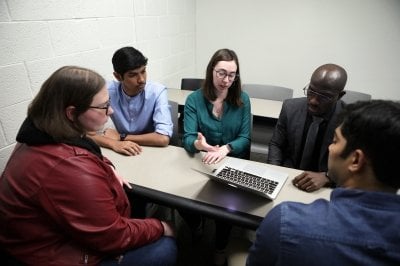
Gina Adragna, Djinaud Prophete, and Narendra Gude
Foundations of Health Informatics
The new 12-credit-hour Foundations of Health Informatics certificate provides training in fundamental topics such as security and privacy,
data analysis, programming, and system analysis. Its completion, along with two of
the three 9-credit-hour focus area certificates below, leads to an MS in Health Informatics.
Artificial Intelligence in Healthcare
The healthcare industry produces trillions of gigabytes of raw data annually. AI in Healthcare certificate students learn AI concepts, methods, and tools, building a strong foundation
in computer science, healthcare, and machine learning to bridge AI and medicine.
Public Health Informatics
Managing and deriving valuable information related to public health is critical today.
Public Health Informatics certificate students gain proficiency in health data definitions and standards, learn
the basic functions and operations of public health information systems, and acquire
skills to plan and manage public health information systems projects.
Security and Privacy in Healthcare
Healthcare privacy is complex—and the importance of safeguarding personal healthcare
information and protecting hardware and software systems against attacks cannot be
overstated. The Security and Privacy in Healthcare certificate program helps students build a solid foundation in computer science,
risk management, and cybersecurity.
Michigan Technological University is a public research university founded in 1885 in Houghton, Michigan, and is home to more than 7,000 students from 55 countries around the world. Consistently ranked among the best universities in the country for return on investment, Michigan’s flagship technological university offers more than 120 undergraduate and graduate degree programs in science and technology, engineering, computing, forestry, business and economics, health professions, humanities, mathematics, social sciences, and the arts. The rural campus is situated just miles from Lake Superior in Michigan’s Upper Peninsula, offering year-round opportunities for outdoor adventure.
link